Since January 1, 2024, New York City has required annual parapet inspections for most buildings — and many Manhattan owners and boards are still catching up with what Local Law 126 actually demands. This guide covers who must comply, what a compliant inspection involves, the defects inspectors flag most, and what to do when your parapet needs repair.
What Local Law 126 Requires
Local Law 126 of 2021 added an annual parapet observation requirement to the NYC Construction Codes (Section 28-301.1 of the Administrative Code and the DOB’s parapet rule). In plain terms: the owner of a building with a parapet facing a public right-of-way must have that parapet observed once a year by a competent person, and must keep a written report of the observation on file, available to the DOB on request. Buildings are grouped into staggered compliance cycles by borough/community district, so your first required inspection year depends on your building’s location — but the annual rhythm applies citywide once your cycle begins.
Who Must Comply — and Who Is Exempt
The requirement applies to buildings with parapets fronting streets, sidewalks, and other public rights-of-way — which in Manhattan means most co-ops, condos, rentals, and mixed-use buildings, including many brownstones and townhouses. Detached one- and two-family homes are the notable exemption. If your building has a parapet along any public frontage, assume the rule applies until you confirm otherwise.
What a Compliant Inspection Looks At
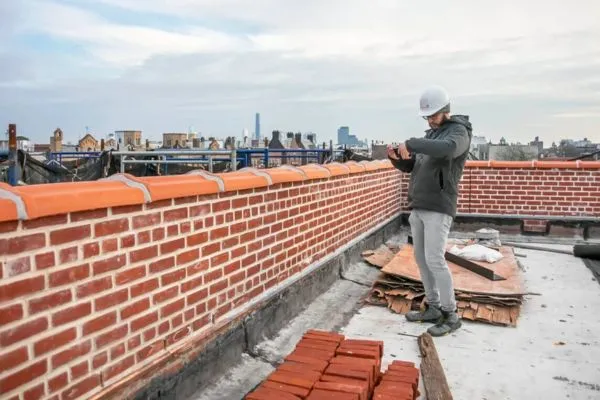
A proper parapet observation is hands-on, not a glance from the sidewalk. The inspector examines the parapet from the roof side and, where accessible, the street side, checking for the conditions that make parapets fail: deteriorated or washed-out mortar joints; cracked, spalled, or displaced bricks; leaning or bulging sections; failed or missing coping stones; open joints at the coping; deteriorated through-wall flashing; and appurtenances — railings, signs, antennas, and similar attachments — that are loose or improperly supported. The written report records the parapet’s condition, notes unsafe conditions, and states the inspector’s determination. Our parapet wall repair page details the repair side of this work in full.
The Defects Found Most Often in Manhattan
Parapets live the hardest life of any wall on the building: they are exposed to weather on both faces and on top, and they move with every temperature swing. The recurring findings are failed coping joints that let water pour into the wall, mortar loss at the top courses, and corrosion of embedded steel that expands and cracks the masonry from inside. Buildings that also carry decorative coping or historic detailing face an additional choice — repair approaches that preserve the original look, which is exactly what our decorative parapet wall finishes service covers.
If the Inspection Finds a Problem
Findings fall into two practical buckets. Maintenance items — repointing, coping joint renewal, localized brick replacement — can be scheduled promptly and inexpensively relative to structural work. Unsafe conditions — displaced masonry, significant leaning, loose appurtenances — require immediate action to protect the public, and may also intersect with your Local Law 11 (FISP) facade obligations if your building is over six stories. Either way, the same team that inspects should be able to price the fix; an exterior repair scope often combines parapet, facade, and flashing corrections in one mobilization.
How Parapet Repair Costs Are Built
Pricing follows the amount of wall involved and, above all, access. A roof-level parapet reachable from the roof is far cheaper to repair than a section requiring street-side scaffolding. Rebuilding a deteriorated parapet section, replacing coping, and installing proper through-wall flashing costs more than repointing — but it resets the wall’s service life instead of buying another season. An itemized estimate separates the urgent from the deferrable so boards can phase work intelligently.
FAQs
How often must parapets be inspected under Local Law 126?
Once a year, every year, with the written observation report kept on file at the building. Your building’s compliance cycle determines reporting specifics, but the annual observation itself is ongoing.
Who can perform the inspection?
The observation must be done by a competent person — someone capable of identifying parapet hazards, which includes licensed design professionals, qualified exterior wall inspectors, and trained individuals working under appropriate supervision. Choose someone who understands masonry failure, not just paperwork.
Does Local Law 126 replace Local Law 11?
No. Local Law 11 (FISP) is a separate, periodic facade inspection program for buildings over six stories with its own filing cycle. LL126’s annual parapet observation sits alongside it — and a healthy parapet helps your FISP results too.
What happens if we skip the inspection?
Owners who fail to observe and document parapets face DOB enforcement exposure, and — more practically — undetected parapet deterioration is a public-safety hazard that can lead to emergency orders, violations, and liability if masonry falls.
Stay Ahead of the Annual Requirement
Treat the parapet inspection as an early-warning system, not a chore. Spark Construction Manhattan performs parapet repairs and rebuilds across Manhattan and can assess your parapet, document its condition, and price any corrections in one visit. Request a free estimate on our contact page.