
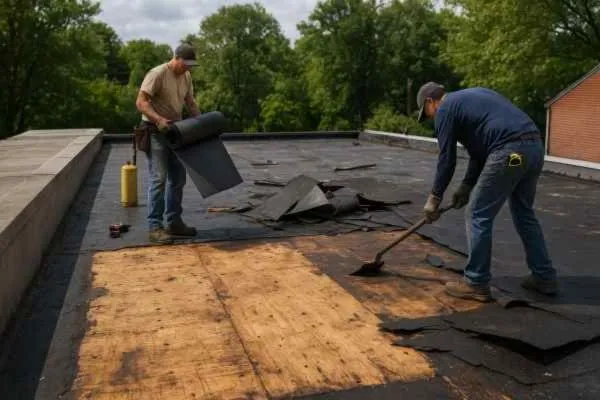
Almost every flat roof decision in Manhattan starts the same way — a stain on a top-floor ceiling and an owner asking one question: can this be repaired, or do I need a new roof? Answering it wrong is expensive in both directions. This guide lays out how roofing professionals actually make the call, the signs that point each way, and the Manhattan-specific factors that change the math.
First: Find the Real Source of the Leak
A ceiling stain tells you where water entered the apartment, not where it entered the roof. On flat roofs, water travels — along deck seams, under membranes, and through insulation — sometimes emerging rooms away from the actual breach. Professional leak diagnosis starts at the roof: seams, flashing at parapets and penetrations, drains, and ponding areas. Not every “roof leak” is the roof at all: failed parapet wall coping and cracked masonry joints above the roofline channel a surprising share of top-floor water. Repairing the roof while the parapet leaks guarantees a second stain.
When Repair Is the Right Call
Repair makes sense when the membrane is fundamentally sound and the problem is localized: a split seam, failed flashing around a vent or hatch, a puncture, or a single ponding area correctable with tapered material. The roof’s age matters — a membrane in the first half of its service life with isolated defects is a repair candidate. So is a roof whose insulation is dry: if the system beneath the membrane is intact, targeted repairs restore full performance at a fraction of replacement cost. Our roof repair and installation page describes how we scope both paths.
When Replacement Is the Honest Answer
Replacement becomes the economical choice when repairs stop being exceptions and become a subscription. The classic signals: leaks recurring in different locations; widespread seam failure or membrane cracking and shrinkage; saturated insulation (which destroys insulating value and adds structural load); ponding water standing more than 48 hours after rain across broad areas; and a membrane at or past its expected service life — roughly 15–20 years for modified bitumen, 20+ for EPDM and TPO in good installations, less for neglected ones. Patching a systemically failed roof spends real money to delay an inevitable replacement while water keeps damaging the deck and the apartments below.
The Middle Option: Roof Coating and Restoration Systems
On some sound-but-aging roofs, a professionally applied restoration coating extends service life meaningfully at well below tear-off cost. The conditions are strict: the membrane must be adherent, the insulation dry, and drainage acceptable. Coating over a wet or failing system traps problems instead of solving them — a reputable contractor will core-sample before recommending either path.
Manhattan Factors That Change the Decision
Access and disposal dominate city roofing economics. Tear-off debris leaves by chute, crane, or elevator; materials arrive the same hard ways. Neighboring buildings sit inches away, bulkheads and mechanical equipment crowd the roof, and many buildings need the work coordinated with facade or parapet projects already underway — combining roof replacement with parapet rebuilding while access is in place is one of the most reliable savings in exterior repair planning. Buildings should also weigh Local Law 11 facade cycles and any planned rooftop amenities before choosing a repair horizon.
What Either Path Should Include
Whether you repair or replace, insist on the unglamorous essentials: correct drainage slope toward drains, renewed flashing at every penetration and parapet base, sealed seams verified by inspection, and photo documentation of the work. These details — not the membrane brand — decide whether the roof above your top floor stays boring for the next two decades.
FAQs
How long does a flat roof last in NYC?
Service life depends on the system and maintenance: modified bitumen typically 15–20 years, EPDM and TPO often 20 years or more. Annual inspections and prompt seam and flashing repairs are what let a roof reach the top of its range.
Can a new roof be installed over the old one?
Sometimes — a recover is possible when the existing roof is dry, adherent, and within code limits on roof layers. When insulation is saturated or the deck is damaged, tear-off is required. A core sample answers this definitively.
How long does flat roof replacement take?
A typical Manhattan building roof takes several days to two weeks depending on size, tear-off requirements, weather, and access logistics. Your contractor should phase the work so the building is never left unprotected overnight.
Will a roof replacement disturb top-floor residents?
Tear-off creates noise and vibration during work hours, and buildings usually notify residents in advance. Experienced crews protect interiors, manage debris routes, and keep the schedule predictable.
Get a Diagnosis Before You Buy a Roof
The repair-versus-replacement question has a correct answer for your building — it just cannot be found from the ceiling stain alone. Spark Construction Manhattan inspects flat roofs across Manhattan, traces leaks to their true source, and gives you both prices with an honest recommendation. Request your free inspection on our contact page.